
Are We Doing Capitalism Wrong? Can We Fix It?
Capitalism is run by voting - with dollars. What if we take ownership for this and change how we make purchases? Maybe with a collectively intelligent buyer’s club PMA....

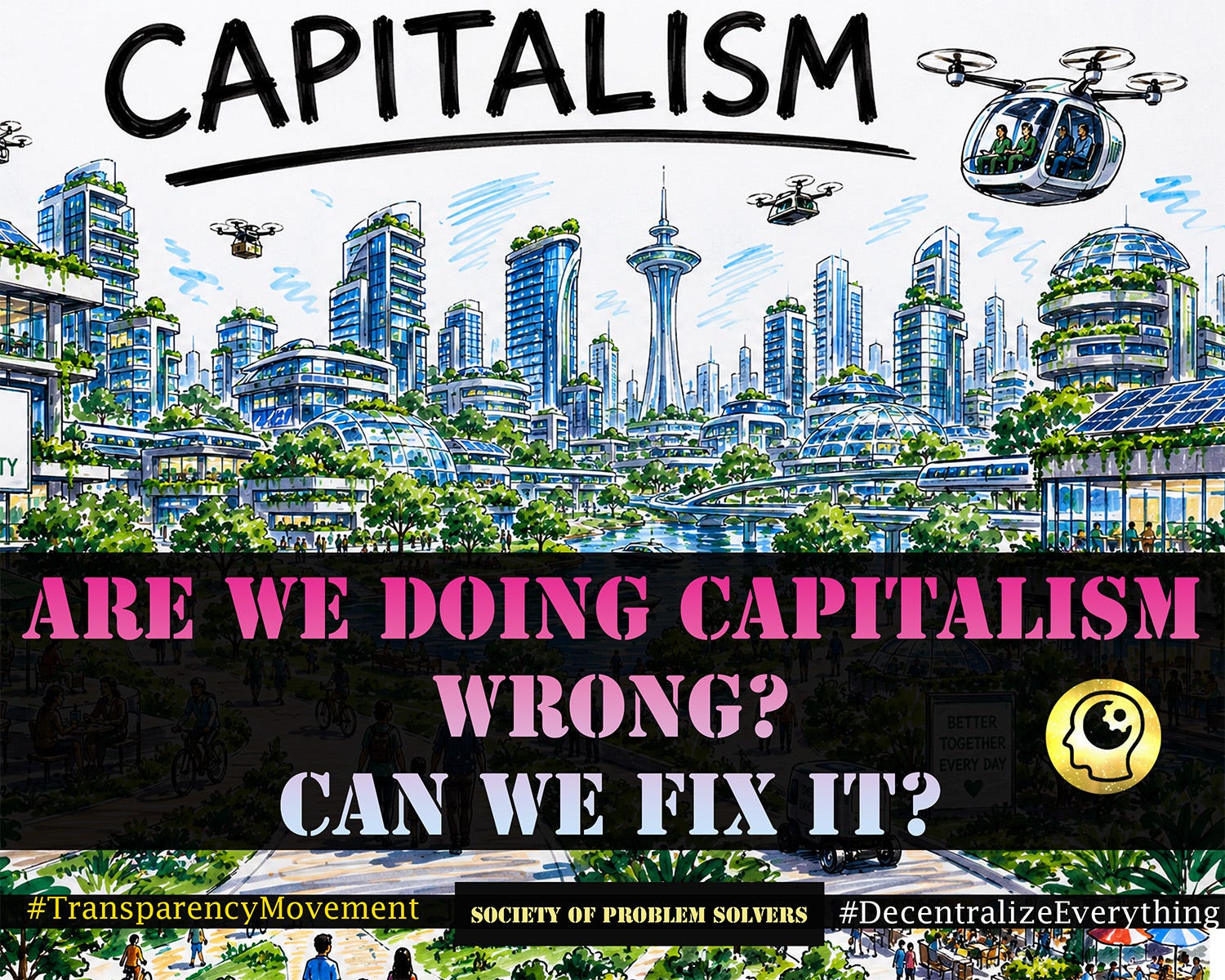
We recently read an eye-opening article titled Capitalist Democracy Is NOT an Oxymoron - You’re Just Doing Capitalism Wrong, by Paul Foulds.
FULL ARTICLE:

Of course trying to defend or promote anything to do with capitalism today is an extremely hot button issue. In Paul’s own comments on his article posted in Substack Notes he said:
‘I’ve been getting some really interesting feedback about this article. Most of it has centred around the word ‘capitalism’. … the idea that capitalism is inherently evil.
I understand that position, but it may be blinding us to something strategically valuable.
As way of explanation, consider this:
Capitalism = The Terminator
There are those who want to destroy the terminator. That makes sense, but the terminator is strong. Really strong.
Instead, I propose that we reprogram it.”
In our writings here at the Society of Problem Solvers we have brought forth similar arguments, for example how we can DECENTRALIZE capitalism, or even GAMIFY it and take it over by playing a digital game of pooled resources, like SIM CITY but for reality.
For our articles on this topic, we had a lot of similar pushback that Paul experienced, but realized that most of those people were “group signaling.” CAPITALISM IS THE ENEMY! or CAPITALISM IS THE BEST WAY YOU COMMUNIST! are war cries that signal to the groups out there what group you belong to. And that is understandable, because the groupthinkers got it half right - we are indeed at war. It just isn’t with each other, or even with capitalism. Rather it is with the people who have corrupted all of our systems. So Paul’s reframing of capitalism shed a bright light on how all of the people in this ‘New Economy / Exit and Build ’ movement could possibly flip the script rather quickly and fix this mess we are in.
Paul asks readers to separate capitalism itself from the particular version of capitalism most of us have experienced - this corrupt “puke flavored” one. His argument begins with an important distinction: neoliberalism - the market-first philosophy that came to dominate much of the Western world beginning in the 1980s - is one form of capitalism, but it is not the only form capitalism can take. Foulds is not especially interested in defending the system as it currently exists, nor is he trying to win a narrow argument over labels (neither are we). He is asking a more useful question: Can a market economy based on voluntary exchange coexist with a meaningful democracy?
Or maybe even act as one?
Foulds believes that it can, but only if we expand our understanding of what voting means. Most people think of voting as something that happens at a ballot box every few years. Yet, as he argues, we also vote with our wallets by deciding which businesses receive our money, and we vote with our feet by deciding which employers, institutions, communities, and organizations continue to receive our participation. These less formal kinds of voting happen far more frequently than elections do. They continuously distribute power throughout society, rewarding some institutions while withdrawing support from others. Yet we take this kind of voting way less seriously.
As Foulds writes, “Capitalism simply rewards competitive advantage.” It does not possess a conscience of its own. It rewards whatever behavior succeeds under the conditions we create. When exploitation lowers costs and consumers continue purchasing anyway, exploitation may become an advantage. When employees cannot afford to leave, poor treatment may become an advantage. But when customers possess reliable information, workers have realistic alternatives, and ethical conduct attracts both talent and business, the incentives can begin moving in a different direction.
The difficulty is that voting with our wallets is much less democratic in practice than it appears in theory. People do not enter the marketplace with equal amounts of money, time, knowledge, or freedom. A wealthy person has far more discretionary purchasing power than someone struggling to pay rent. Many consumers cannot afford to choose the most ethical option even when they know what it is. Others have no meaningful alternative available to them. A person may dislike the labor practices of a dominant retailer but still depend on its low prices, nearby location, or rapid delivery. A worker may distrust a large bank but have no locally owned institution offering the services the worker needs. An entire community may want healthier food, cleaner manufacturing, better employment, or more responsible technology without having any realistic way to demand that such businesses come into existence.
Additionally, most consumer decisions are made individually and almost entirely without coordination. We are told to vote with our wallets, but we generally do so alone. We act from habit, necessity, need, convenience, price, advertising, reputation, and whatever information happens to reach us. Even people who genuinely want to support ethical companies may not have the time to investigate supply chains, compensation practices, ownership structures, chemicals in products, environmental records, political spending, profit margins, company transparency, customer complaints, and community impact before buying a cup of coffee or choosing a contractor. The modern economy is too large and opaque for each person to evaluate independently.
That is why individual consumer choice, although important, rarely develops into sustained collective power unless the corruption becomes so overwhelming - for example like the tobacco companies of the 1980s or the obvious Wall Street processed food companies of today (which have lost about 30% value in the last two years on average). Sure, one person can stop shopping at a Wall Street owned chain, but the company may never notice. Ten thousand people may quietly reach the same decision without knowing that anyone else has done so. Their choices remain scattered, mostly invisible, and easy for the larger system to absorb. And they don’t come with demands. We are technically voting, but our votes are not being discussed, counted, interpreted, or directed toward a shared objective.
The missing ingredient may be collective intelligence and the systems that support it.
Foulds describes three forms of voting: voting with ballots, voting with wallets, and voting with our feet. We would propose a fourth that combines all three under an umbrella: voting together. By using structured systems of collective or “swarm” intelligence, groups of people can share information, compare experiences, challenge assumptions, investigate alternatives, and coordinate economic decisions without surrendering their individual freedom. The purpose would not be to tell everyone what they are permitted to buy. It would be to give people a better way to understand what their purchases support and a practical way to magnify the influence of their choices, and offer alternatives that fit a culture we all set together. For example, what companies we as a community feel we should boycott. And what ones we feel we should support, and why.
A Private Membership Association (PMA), operating in conjunction with a “buyer’s club,” could provide the structure for such a system. This idea was brought to us by ParaGov here on Substack. Members could voluntarily agree upon a code of conduct, identify the values we want our New Economy to reflect, and work together to evaluate the businesses competing for our support. This eventually would include government contracts as well.
Rather than relying on conventional advertising, vague claims of social responsibility, or online reviews that can be manipulated, members could gather information directly, examine evidence, question business owners, hear from employees and customers, and arrive at recommendations through transparent collective deliberation.
As we write about often, healthy collective intelligence depends upon independence, disagreement, criticism, and the freedom to opt out. A PMA association could do all of that and more. Members would still decide how to spend their own money, but they would make those decisions with access to the knowledge, experience, and investigative capacity of the larger group. And the collective buying power a PMA or Buyer’s Club can be used to pressure businesses to comply with demands.
The law that the consumer has the most control over is supply and demand. If we demand better in unison - unlike what we see with political voting - in a market someone will give it to us.
The significance of a PMA Buyer’s Club model is not simply that members might receive discounts by purchasing in bulk - although that would be one benefit for sure. Its deeper purpose would be to create a self-aware economic network capable of observing where all of its money flows and what consequences follow. Most communities have little idea how much of their wealth leaves through national retailers, financial institutions, Wall Street, online platforms, insurance companies, food distributors, contractors, and service providers. Money enters through wages and local commerce, then quietly exits toward distant corporations whose ownership, conduct, and priorities may have little connection to the people generating that revenue.
A collectively intelligent buyer’s club PMA could begin mapping those flows. It could ask which purchases already support trustworthy local or member-owned businesses, which purchases send money outside the network, and which unmet needs represent opportunities for new enterprise. The goal would not be to seal members inside a closed economy or refuse all outside trade. No community can or should produce everything it consumes. The goal would be to become more intentional - to keep value circulating among businesses and people who have earned the network group’s trust whenever doing so is practical, while remaining open to outside companies that meet the same standards.
A Network of Networks tied to a common new code of conduct for our New Economy.
When money repeatedly leaves the PMA network because no suitable alternative exists, the association would not have to stop at complaint or boycott. It could treat that gap as a problem to be solved. Perhaps an existing local company could expand to meet the need to access our massive buying power? Perhaps the group could recruit an ethical operator willing to adhere to our new code of conduct from another region and get them to join or work with the New Economy network? Perhaps one of the PMA’s members already possesses the experience and interest required to start the business. In that case, the association could help the entrepreneur understand the demand, refine the model, find expertise, identify customers, and - through properly designed and lawful arrangements - assemble the resources necessary to launch within our network.
This changes the role of the consumer. Members are no longer merely choosing from a menu created by someone else. They can help create the menu - the new economy - and make sure it aligns with the culture we set. They can identify the kinds of companies they wish existed and then participate in bringing them into existence. A coordinated group that already knows it needs a grocery store, repair company, childcare cooperative, technology service, construction firm, health clinic, or local manufacturing operation can provide a new enterprise network with something most startups spend years trying to find: an informed and committed base of customers.
Eventually, since our world is currently set up this way, the Network could lobby into government as well and change the laws that benefit the New Economy. But changing government is a much harder task than coordinating our purchases would be.
Also, simply creating more “businesses” is not enough. Unless those businesses are designed differently, the same incentives and habits will eventually reproduce the same problems. A new company can become just as extractive, secretive, or disconnected as the company it replaced. For that reason, businesses created by or admitted into the network should strive to follow a shared ethical code built around what we call the Five Pillars of Ethical Business - and wrote about HERE.
The first pillar is the business itself. An ethical business must remain financially viable. If it cannot pay its bills, maintain its operations, withstand setbacks, take care of employees, and produce a reasonable profit, it will eventually fail and cease helping anyone. Profit should therefore not be treated as evidence of wrongdoing. Profit is the fuel that allows a healthy business to survive, improve, employ people, correct mistakes, invest in its community, and pursue long-term goals.
The second pillar is the customer. Customers should not be treated as targets from whom the maximum possible amount of money must be extracted. They should be treated as long-term participants in a mutually beneficial relationship. In doing so they should be part of the collective intelligence swarming process (which we write about all the time such as HERE). Want us to carry a product that you are okay with us making a fair 30% profit on? Tell us, we will carry it. Want us to independently test our oatmeal for glyphosate and chemicals? Tell us, we will. In a collective intelligence PMA Buyer’s Club, the customer would have a direct voice.
The third pillar is the employee. Businesses often say that their employees are their most valuable resource, yet many behave as though labor were merely an expense to be minimized. An ethical business should be proud to explain how its employees are compensated and treated. When employees are respected, fairly paid, given opportunities to grow, and meaningfully included in decisions that affect their work, the company becomes more capable, stable, and trustworthy. We should all want to shop at companies that take care of the people that make them up. So we will.
The fourth pillar is the community. Every business depends upon public infrastructure, safe neighborhoods, and the accumulated trust of the place in which it operates. Ethical companies should recognize this. Community responsibility does not need to mean performative charity or carefully staged photographs. It can mean hiring locally, mentoring young people, supporting neighborhood projects, sharing expertise, contributing to civic life, helping maintain public spaces, and finding practical ways to strengthen the community that sustains the business.
The fifth pillar is the environment. Every business operates within natural systems that no balance sheet fully captures. Ethical conduct requires minimizing avoidable environmental harm within reasonable and economically realistic bounds, while continually looking for better materials, processes, energy sources, transportation methods, and waste practices. Perfection is not a credible standard, and environmental responsibility should not become an excuse for hiding tradeoffs or making empty claims. The responsibility is to measure harm honestly, reduce it where possible, and keep improving.
LET’S GET CLEAR
For these pillars - or any that we might add later as a PMA swarm - to mean anything, they must be accompanied by radical transparency. Modern businesses often ask the public to trust them while revealing as little as possible about how they operate. Customers may have no idea how prices are determined, how workers are compensated, where products originate, how much profit is being made, what complaints have been received, or what happens when the company causes harm. This secrecy makes meaningful consumer choice nearly impossible and encourages businesses to treat public relations as a substitute for ethical behavior.
A radically transparent company would take a different approach. It would explain, in understandable terms, where customer money goes, what employees earn, how major decisions are made, what failures have occurred, and what corrective actions are underway. Customers would not necessarily object to a business earning healthy profits if they could see that those profits were earned honestly and used constructively.
Transparency should also lead to participation. Businesses within the network could use swarm-intelligence systems to consult employees, customers, and PMA members about important questions. Employees often understand operational problems that executives never see. Customers identify needs and frustrations that businesses fail to capture. Community members recognize consequences that are invisible from inside the company.
This is where our proposal intersects most directly with Foulds’s emphasis on walkaway power. He argues that when people cannot realistically leave a bad job or institution, exploitation may become the winning strategy. A coordinated economic network can help create the alternatives that make walking away possible. A worker trapped in a poor job has limited power. A worker who belongs to a network of transparent businesses, informed customers, potential employers, entrepreneurs, and mutual support possesses more options. Similarly, a customer who dislikes a dominant corporation but has nowhere else to go has little influence. A customer connected to a buyer’s club capable of supporting or creating alternatives has considerably more.
Walkaway power is not created merely by telling people to be brave enough to leave. It is created by building somewhere for them to go - a New Economy. You know, Exit and Build.
The great appeal of this approach is that it does not require us to win control of the government before beginning. We can do it without permission. In fact, we can start voting today (and every day), with our dollars.
We can begin by organizing voluntarily (maybe on a platform like THIS). We can make it easier for good companies to find loyal customers and harder for exploitative companies to hide behind convenience, branding, size, or government. Most importantly, we can begin changing the competitive environment itself so that transparency, good employment, customer care, community investment, and environmental responsibility are not merely admirable sacrifices. They become reasons a business succeeds.
Perhaps capitalism is not one thing that must either be defended in its present form or destroyed in its entirety. Perhaps it is a broad category of systems whose outcomes depend upon what we demand of them. Foulds writes that “change the incentives, and capitalism rewards different behaviour.” (he is If true, we believe coordinated purchasing and collective intelligence can become a driver of that change.
Every dollar may be a vote, but an isolated vote is easily lost in the noise. A community that learns to investigate together, decide together, market together (imagine 1 million of us posting online the same day about our new regenerative farm shop joining the Network, and inviting the world to the grand opening of it), purchase together, and build together can turn millions of scattered transactions into a powerful coherent economic signal. It can reward companies that care for themselves, their customers, their employees, their communities, and the environment. It can expose businesses that speak the language of ethics while behaving otherwise. And when the right companies do not yet exist, it can help create them.
We do not need permission to become wiser customers, more responsible owners, better employers, or more organized communities. We do not need permission to direct our money toward people and businesses that have earned our trust.
Once we realize that our unified “votes” with our dollars could easily turn into a force for change in a peaceful and quickly executable manner, the question is simply: are we willing to take responsibility for the part of the system that we already control?
We are, indeed. And it seems many of us unique problem solvers are converging into an optmistic plan before our eyes.
Thanks for reading!
We are better problem solvers, together. It is testable using collective swarm intelligence systems. Subscribe to The Society and see! It is free:
“All problems that do not defy the laws of physics are solvable with the right knowledge -
and……… solving problems is happiness!” David Deutsch
#SwarmAcademy #LEADERLESS #ResultsMatterMost #DecentralizeEverything #DemandTransparency CollectiveIntelligence #SwarmIntelligence
Message us to submit your articles for publication. We are a collective of writers and ideas. We are free but someday might take donations that we pool and let our readers decide how to spend using collective intelligence.
We fix the world. How? We build genies like this
Capitalism is not evil. I’ve written on here about growing up in a small midwestern town at the birth of neoliberalism. At that time and place, it was still pretty balanced, but the capitalism was formal and the socialization was all informal.
Neoliberalism obliterated that balance. That is why China has now become the development template and partner for most of the rest of world, not the USA or UK. China has stumbled upon the right solution - a socialist base with capitalism layered on top to drive innovation. Capitalism is optional, not mandatory. Your basic needs are provided for by society and aren’t tied to your job.
People’s basic needs need to be met primarily, not conditionally, just like children need to be loved unconditionally, and not conditionally, to grow up sane. Why my Chinese friends are all happy and why the USA is currently falling apart…
I owned a business and played the game in the USA for 20 years, and I can tell you it is completely rigged and I absolutely hated it and the people who enforced it. I only wanted to help people and my thanks was getting robbed and abused, so I simply don’t care to help anymore. The only way to get out of it was to throw the game board off the table and leave the USA and all of its lunatic neoliberal supporters behind completely.
The PMA idea is an excellent way to reclaim consumer power by creating competition to defang corporate capture.
Excess wealth has ganged up against humanity, bulldozing antitrust laws meant to protect us. Unregulated capitalism has grown malignant. Human life now finds itself hostage to private corporations’ greed. And our government has jumped in with both feet.
Any way we can come up with to survive without enabling those who feed off us weakens them and strengthens us. Humans are creative. It’s our power. PMA’s are a great idea. There are more. We don’t need a huge majority or a corporate takeover. Many small groups coming together, inspired by similar interests and strengths, add up to real competition. They provide alternatives. Bit by bit we weaken the Corporate Monopoly and build a decentralized government Of the People By the People, AKA a real democracy.