
Solve Problems With Better Systems, Not People
Attention System’s Thinkers: Don't trust, verify.

Aloha, Problem Solvers!
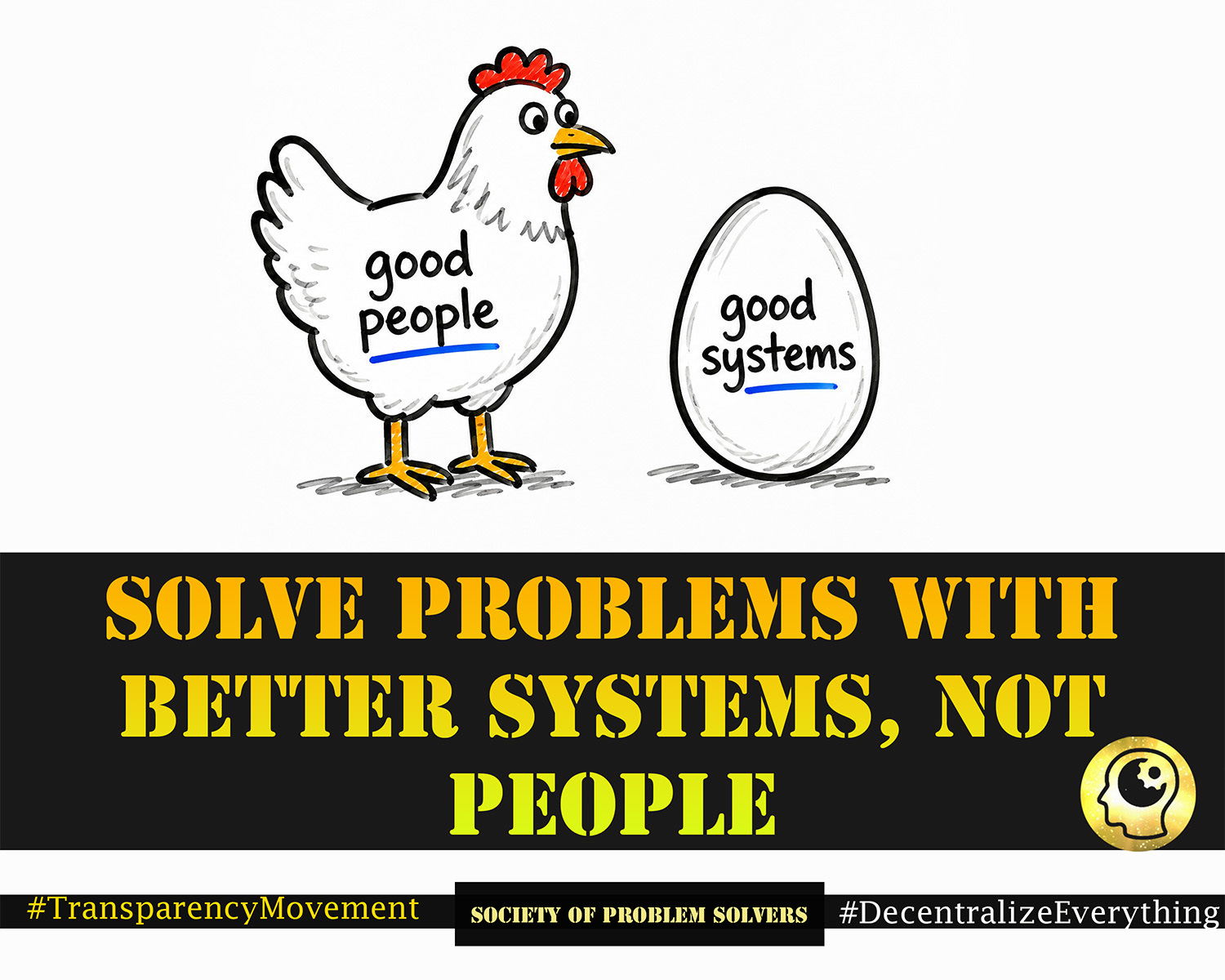
Which comes first: better people or better systems?
It’s the classic chicken-and-egg problem.
At first glance, it seems like we need good people to build good systems. But it also fails to account that thinking itself is a system, and good people are largely defined by how they think.
For the sake of argument here, let’s define “good” as simply getting good results so we don’t devolve into nonproductive philosophy. What systems for humanity can you name that are currently getting good results?
Even if you think that good people come first, those good people almost certainly have other self-imposed systems that help them become “good.” Humans are unique because we can use reason and logic to override many of our natural impulses. We enjoy eating unhealthy foods, sex, taking risks, gambling, and having our egos boosted through social approval. Yet most of us don’t let those desires completely control or ruin our lives. We build systems - habits, routines, rules, cultures, codes, disciplines, and principles - that help us become the people we want to be.
There is one truth that is impossible to ignore:
Good systems create good people.
Not always, of course. But on average…and by a wide margin.
Think about it. A child raised in a system that values curiosity, honesty, self-reflection, and critical thinking is more likely to develop those same traits. We see this pattern repeatedly in evidence surrounding growth mindset, education, and the influence of nature versus nurture.
The same principle appears everywhere else too.
Workplaces with incentives for cooperation and accountability tend to produce more trustworthy teams. Healthy food environments make healthy eating easier. Well-designed training systems create better athletes. In nearly every area of life, the systems around us shape our behavior.
Well-designed systems help ordinary people make better decisions consistently, because at the root, none of us are perfect.
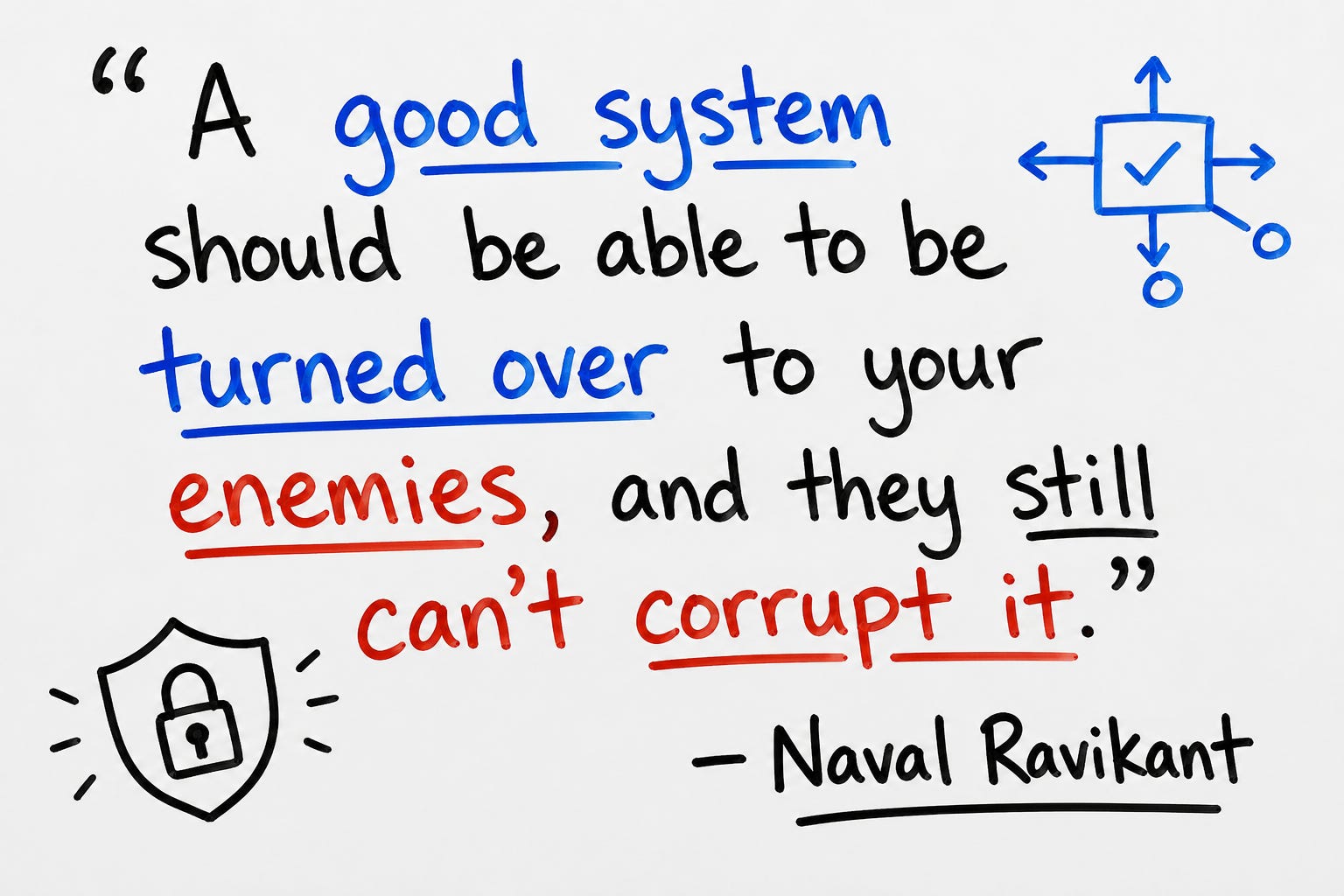
That’s why effective problem solvers don’t begin by asking, “Who should we blame?” They ask, “What system allowed this to happen?” As Naval Ravikant likes to say: “A good system should be able to be turned over to your enemies, and they still can’t corrupt it.”
Whenever possible, good problem solvers solve problems with systems.
If you struggle to say no to chocolate, is it better to keep a cupboard full of candy and fight temptation every day? Or is it better to design a system where you don’t keep chocolate in the house and the temptation isn’t sitting in your kitchen?
If you’re being bullied, is it better to hope you’ll somehow become tougher on your own? Or is it better to adopt a proven system like jiu-jitsu, Muay Thai, strength training, and disciplined practice that gradually transforms you into someone capable of defending yourself?
The answer is obvious. A good system should first be judged by its results. Then it should be judged by how difficult it is to corrupt.
If we use those two simple criteria to evaluate humanity’s current systems, how are we doing? Nearly all of our main systems are getting bad results and are corrupted.
It is time to build systems that reward truth over popularity. Reward cooperation over division. Make corruption difficult instead of merely hoping for honest leaders. Design transparency and verification into the process instead of relying solely on trust. Build feedback loops that continuously detect errors, encourage criticism, and improve over time.
The greatest advances in civilization have rarely come from finding perfect people. They have come from inventing better systems - scientific methods, markets, constitutions, engineering standards, quality control, healthier ways of eating, more productive ways of exercising, better ways of thinking, more proven ways of solving problems, better computers, safer cars, more effective ways of collaborating, and countless other frameworks that allow imperfect humans to accomplish extraordinary things together.
The goal is to build systems that produce good outcomes knowing full well that the people inside them are imperfect.
If when faced with a problem you are asking : “Who can we vote for that can better solve this problem?” Or, “Who can we hire to fix our problem?” You are already asking the wrong questions.
Good problem solvers ask:
Why did this happen? And, how could we redesign the system so this problem becomes less likely to happen again?
As we wrote about before, ALL people are corruptible. And even if someone isn’t corrupted yet, trust in people is always only a temporary thing. Trust fades. New temptations or fears arise. Any system that counts on trust in one person will eventually fail. The failure point will be that person. On the other hand, trust in systems (or larger groups of people instead of individuals called “swarms” like we wrote about HERE) remain more reliable and much harder to corrupt.
In the long run, better systems don’t just solve today’s problems.
They create better people.
And those better people, in turn, become better at designing systems that solve even bigger problems.
In this scenerio, we are neither the chicken nor the egg. Rather, we are the farmer that raises both.
Solve your problems with better systems, and see. It is testable.
Thanks for reading!
We are better problem solvers, together. It is testable using collective swarm intelligence systems. Subscribe to The Society and see! It is free:
“All problems that do not defy the laws of physics are solvable with the right knowledge -
and……… solving problems is happiness!” David Deutsch
#SwarmAcademy #LEADERLESS #ResultsMatterMost #DecentralizeEverything #DemandTransparency CollectiveIntelligence #SwarmIntelligence
Message us to submit your articles for publication. We are a collective of writers and ideas. We are free but someday might take donations that we pool and let our readers decide how to spend using collective intelligence.
Absolutely right. Now, let's name these systems:
Bad system = PATRIARCHY - or as the sages say - choose love not fear and patriarchy is fear-based. Before patriarchy, was MATRIARCHY which was a good system, but based on small local groups - and centered, not on mothers, but on the mother-child node - where we ALL started. Everything else resulted from that switch - Capitalism, Corporations, currency (central bank-based loaned-out money) and corruption - c to the 4th power. I urge people to investigate International Online citizen-led Democratic Nations iodnations.org and check out this 5 minute explanatory video. https://www.youtube.com/watch?v=IGE8Ztwo2FQ. Those ready to build an on-line "nationan" of USA residents - of, by, and for the 99% -- The 99% Coalition - USA shoot me and email to larrylangdon@gmail.com and let me know how you want to contribute to the build.
It’s Time to Save America
Tucker Carlson
https://youtu.be/u5h2OCcKYkc
Aug5'26
==
New party emerging on opposition to U.S. wars, AIPAC, and corporate money ???
https://us11.campaign-archive.com/?e=0b3dcb584e&u=70b9fc567465118fa0b7b6e67&id=9646e8ba59
(another 'party' to continue to distract US from the Accountability WE supposedly seek?)
(The BadGuys sending in a Crew to Obstruct The Accountability The BadGuys Fear Coming???)
i.e. 'The 9/11 Commission distraction' / obstruction OP
i.e. 'Warren Commission'
i.e. The DemoRub
etc.
;-)
=
Iran (So Far Away) - Official Music Video
https://youtu.be/D_h7hcK6pFs
=
Trump's Israel Threatening To Nuke USA?
https://youtu.be/bMAm3DPv3v4
;-)