
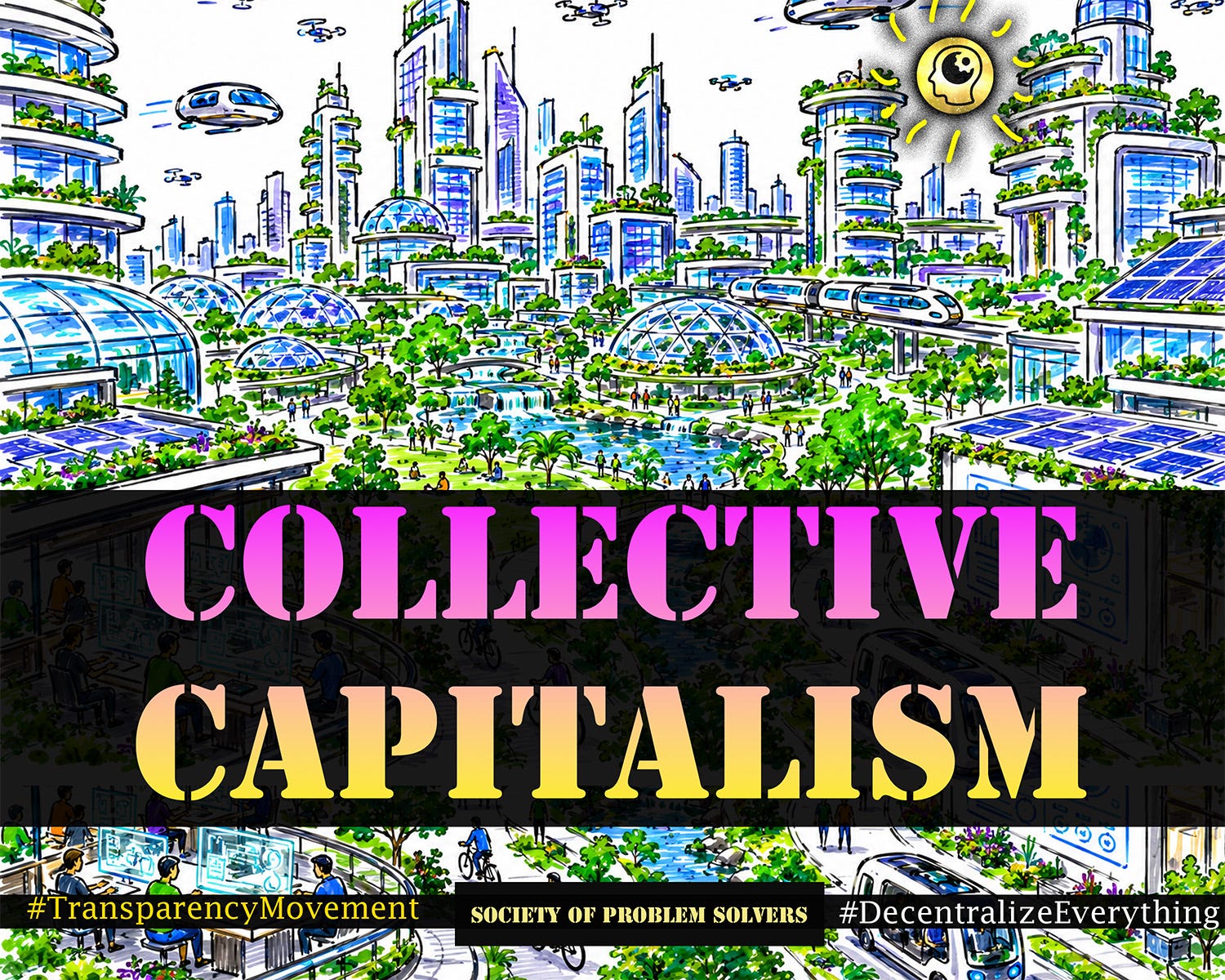
Collective Capitalism
Did we just say a bad word? Which one?

Aloha fellow Problem Solvers,
How many of you hate the term “collective capitalism?”
Most of us have been conditioned to hate either one term or the other - collectivism or capitalism - so we purposely are putting them together here for shock value.
Bang!
But don’t confuse us for socialists or capitalists.
We are systems thinkers, and all systems must constantly evolve to solve new problems. A good system is never finished. It is continuously tested, criticized, improved, and redesigned as new knowledge emerges.
Both socialist and capitalist policies have produced some successes. Both have also produced failures - some horribly epic. More importantly, both have repeatedly demonstrated that centralized concentrations of power - whether political or economic - are vulnerable to corruption, regulatory capture, monopolization, and exploitation.
We need something better. Is it a transparent and decentralized form of Collective Capitalism? Maybe.
But what would that even look like?
No worries. For the exercise, we made up a definition:
Collective capitalism is an economic system that preserves free-market competition, entrepreneurship, and private enterprise while using forms of collective ownership, democratic decision-making, and shared investment, all under a new code of conduct, to ensure that prosperity benefits society as a whole, and at the same time protects the rights and incentives of the individuals within it.
In other words, imagine a system that takes good ideas from successful systems while always remaining open to improvement.
We should preserve the competition, innovation, entrepreneurship, and freedom that well-functioning markets can create. At the same time, we should recognize that markets alone do not solve every problem. Healthy societies also need safeguards that protect people from fraud, coercion, pollution, monopolies, and other market failures.
A modern system should also ensure that people who are disabled, injured, elderly, or temporarily struggling are not simply abandoned. How we treat the weakest members of society says something important about the strength of the society itself.
Likewise, individual rights matter - but so do the long-term interests of the whole community. It is not one or the other as the poorly framed capitalism vs socialism debate would have you believe. It is both. Healthy systems recognize that these are not opposing goals. Protecting the commons and private property, incentivizing both the individual and the group, is possible.
Perhaps the greatest mistake is believing we must choose between capitalism and socialism as though they are the only options available.
Humanity has never stopped inventing better technologies. Why should we stop inventing better systems?
Instead of asking, “Which ideology is correct?” we should be asking, “What system could we make that would produce the best outcomes?”
A truly intelligent society would treat governance, economics, and institutions the same way we treat science itself: as an ongoing process of experimentation, criticism, measurement, and refinement.
No system should be considered sacred. Every rule, institution, and incentive should remain open to improvement. The goal is not to defend an ideology. The goal is to build systems that are increasingly difficult to corrupt, increasingly fertile to creating new knowledge, increasingly fair, and increasingly capable of helping humanity solve its most difficult problems.
For those stuck on thinking socialism is the best answer, this Substack by Max Borders explains why socialism by itself fails.

Like Max alluded to, we already live in a “hybrid” here in America, “a mixed economy.” As a first step, we would just like to see that hybrid have the final say with the people - decentralized and radically transparent, and not with the politicians like it does now. We the people should be able to directly police the referees - the politicians.
As Max mentioned, we don’t need to change what we have now to prove that groups can collaborate and control their own businesses. In fact we are doing this already. We can create a form of “collective capitalism” (get used to the cringe lol) where both the individuals are incentivized, and so is the whole group. This also solves one of the trickiest problems in business - the “agent principle problem.”
With incentive structures and collective decision making tools (like this ONE), we can have collective businesses thriving in the free market. We know because we see the results already happening. Also, we are just beginning to explore this now that we have technology that can build the platforms needed to execute decentralized businesses = Namely Collective Swarm Intelligence systems.
Yes there are co-op employee-owned businesses already. However government makes these systems very difficult to start with rules, red tape and the SEC. Also they use outdated voting methods to make decisions instead of collective intelligence systems.
Because of government regulations, sadly, we couldn’t all just pool $20 a month and start our own Amazon. We SHOULD do this - and start one that is transparent, decentralized, and has a higher code of ethical conduct than the competition at the other Amazon, but we can’t. Calling 10 million people “owners” would come with securities laws, and that code of conduct is not conducive to the cooperation needed to make this happen.
However, we could start a PMA. A private membership association - like a Costco does. And members can get benefits, but not be called “owners.”
This idea come from ParaGov and MJ's The Right Stuff
If you are a socialist reading this - or a capitalist, there is a clear path out of this mess that stops the fake duopoly of systems, and realizes we can build a brand new system, migrate to it, and lock the people corrupting it out of it.
PMAs are a good start. Perhaps we should start with one that builds systems? Then maybe a media one? Read more on PMAs:
The Blueprint for a Parallel Society: PMA 101

What if the most powerful tool for rebuilding our economy and fixing our corrupted systems wasn’t a new law, a new political party, or a billionaire - but a simple private contract?
Is this the best system for humanity? No. Systems never reach their “best” as they should always be evolving. But we can give honest assessments of the results we have seen and use our collective intelligence, creativity, and problem-solving skills to create something new. Something hard to corrupt. Something that gets results. Something that embraces innovation and knowledge creation while also preserving fairness, culture, and a code of conduct that protects the individual and society and helps us grow as one organism, which we are.
The future does not belong to capitalism or socialism.
It belongs to whichever systems adapt to prevent corruption, learn the fastest, and get the best results.
The alternative is tyranny, which both capitalism and socialism result in, without evolving them past where they are today.
Thanks for reading!
We are better problem solvers, together. It is testable using collective swarm intelligence systems. Subscribe to The Society and see! It is free:
“All problems that do not defy the laws of physics are solvable with the right knowledge -
and……… solving problems is happiness!” David Deutsch
#SwarmAcademy #LEADERLESS #ResultsMatterMost #DecentralizeEverything #DemandTransparency CollectiveIntelligence #SwarmIntelligence
Message us to submit your articles for publication. We are a collective of writers and ideas. We are free but someday might take donations that we pool and let our readers decide how to spend using collective intelligence.
We fix the world. How? We build genies like this
Your articles always keep the key issues in sharp focus, with authentic discussion of real-life solutions front and center. Great stuff!
Capitalism is about ownership of capital, the control that ownership confers, and how that ownership is legitimized. Ownership itself has been hijacked by financialized capitalism—the antithesis of collectivism. This system turns money into a proxy for ownership, then—through its control of money creation and the institutional methods for storing surplus—centralizes and entrenches hierarchical control over property.
In a “Collective Capitalism” supported by PMAs, PMCs, DAOs, or any other collective designed for decentralized value exchange and commerce:
How, by whom, and through what mechanism is money created?
And how is the accumulated surplus (represented as money) stored? To build new stronger more stable and sustainable systems by which to define, exchange and create value to be exchanged a strong, stable and sustainable foundation is of paramount importance! Do we think we can put "new wine into old wineskins?"
Thumbs up from Sweded, one of the earliest places where the hybrid called the welfare society was created. Much in the open mind of our social democrat finance minister Ernst Wigforss, who realised that freedom for the masses must mean redistribution, so they have economic margins. ❤️
And also a place where 10% of the economy is coops - keeping the competition sane.