
That's The Spirit!
The Spirit Airlines 2.0 Movement Is About More Than Just Airlines, It's About The Rise of Decentralized Crowd-Owned Institutions

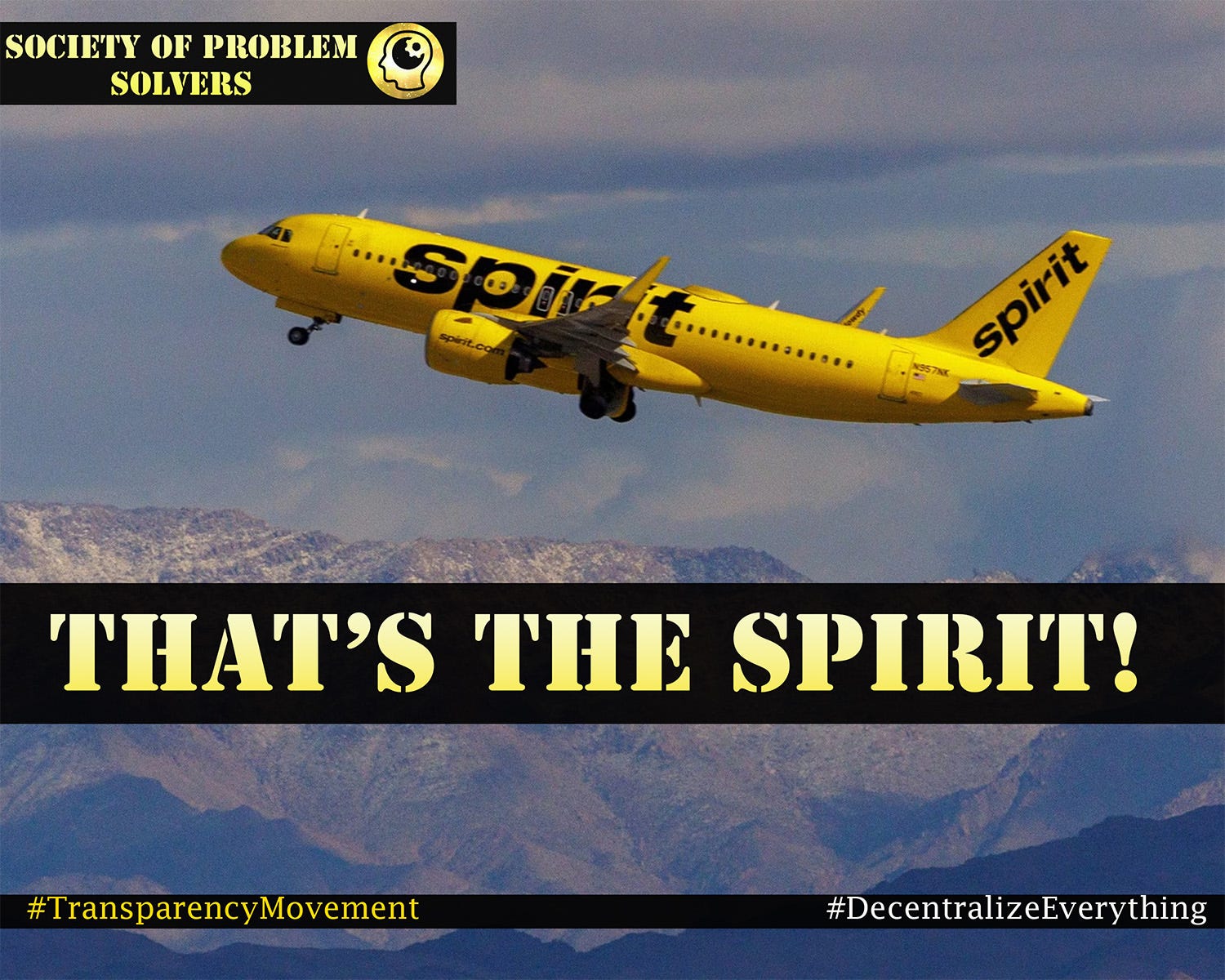
The recent viral effort to “buy” Spirit Airlines may sound absurd at first glance, but underneath the internet spectacle sits a surprisingly revealing cultural moment about ownership, economics, and public frustration with modern corporate systems.
The movement, launched online under the banner “Spirit 2.0,” (found HERE) began after news spread that Spirit Airlines was shutting down operations and facing asset liquidation. A social media creator named Hunter Peterson proposed an unusual alternative: instead of allowing private equity firms or large institutional investors to absorb the remains of the airline, why not let ordinary people collectively purchase it themselves?
The concept drew inspiration from community-owned models such as the Green Bay Packers, where widespread public ownership creates a deeper sense of loyalty and participation. Supporters of the campaign framed the proposal not merely as an attempt to rescue a budget airline, but as a symbolic rejection of the increasingly centralized and corrupted nature of corporate ownership in America.
Within days, the idea exploded across TikTok, Instagram, and online forums. Thousands of people pledged small amounts of money toward the effort, generated hundreds of millions of dollars in non-binding pledges. Whether realistic or not, the proposal resonated - especially with the sense that everyday consumers have little influence over the institutions that shape their lives.
Of course, the practical obstacles remain enormous. Operating an airline requires vast amounts of capital, regulatory approval, insurance, labor coordination, aircraft leasing, maintenance infrastructure, and sophisticated management expertise. Not to mention the airline industry is one of the most heavily regulated - and thus most difficult to compete in - industries out there.
Yet dismissing the movement entirely misses the larger point. The popularity of the campaign reflects a growing appetite for alternative ownership structures and more participatory economic systems. In many ways, the Spirit Airlines phenomenon became less about airplanes and more about whether large organizations can someday be collectively guided by communities rather than solely by concentrated financial interests.
If you follow our writings here, you will know that we are part of this movement, and have offered many ways (including THIS article about how we can become more powerful than the Epstein billionaire class, or THIS article about how we can decentralize and gamify all of capitalism) where it could become entirely feasible to pool resources and start having ethical businesses outside of the iron grip of Wall Street and corrupt venture capital firms.
In our opinion, Hunter Peterson had the right idea, but just the wrong business to start with.
An airline is one of the most centralized, capital-intensive, and heavily regulated industries on Earth. The barriers to entry are immense, the infrastructure is deeply intertwined with government systems, and the opportunities for institutional resistance and corruption are enormous. Trying to collectively purchase and operate an airline as a first experiment in decentralized ownership is like attempting to climb Everest before learning how to hike. Sure, someday we could own our own airline. But not yet.
The larger insight, however, remains powerful: People are hungry for systems they actually trust. They want institutions that feel aligned with the public instead of distant shareholders, private equity firms, or opaque corporate boards. The viral response to the Spirit Airlines idea revealed something deeper than nostalgia for cheap flights. It revealed a growing desire for collective participation in the ownership and the direction of important systems. And we could do this as a network of network, a team of teams, using new systems to help us organize. Imagine a network of new kinds of businesses that adhere to a code of conduct like THIS one.
As fellow Substack thinker Jessica Friday likes to remind us, we could just crowdfund a whole new economy. Max Borders also points out in his book ‘The Social Singularity’ that this form of decentralization should be taken seriously. We should have the right to exit bad systems, and enter new ones. And this absolutely is a novel way we could consider.
But we argue that we shouldn’t start with an airline. We should start with industries that are more agile, more transparent, and more directly useful to everyday life. For example, a new digital communications and problem-solving platform could allow communities to organize ideas, solve issues, hold their governments accountable, and collectively fund projects without relying entirely on advertising-driven algorithms designed to maximize outrage and division. Instead of harvesting attention, such a platform could be structured around collaboration, transparency, and measurable outcomes. We wrote about such a platform HERE if you want to read more. In fact it is our pinned post currently.
Food systems are another obvious opportunity. Imagine a consumer-owned food cooperative that independently tests its own products for pesticides, herbicides, heavy metals, and chemical additives, publishing all results openly to the public. Trust in food institutions is gone, and many consumers increasingly feel trapped between marketing claims and incomplete information. A transparent, collectively owned verification network could become enormously valuable.
Energy cooperatives, local manufacturing networks, decentralized media companies (like THIS one), neighborhood investment pools, and even community-directed research organizations could all emerge from the same underlying principle: distributed ownership aligned around public trust rather than purely financial extraction.
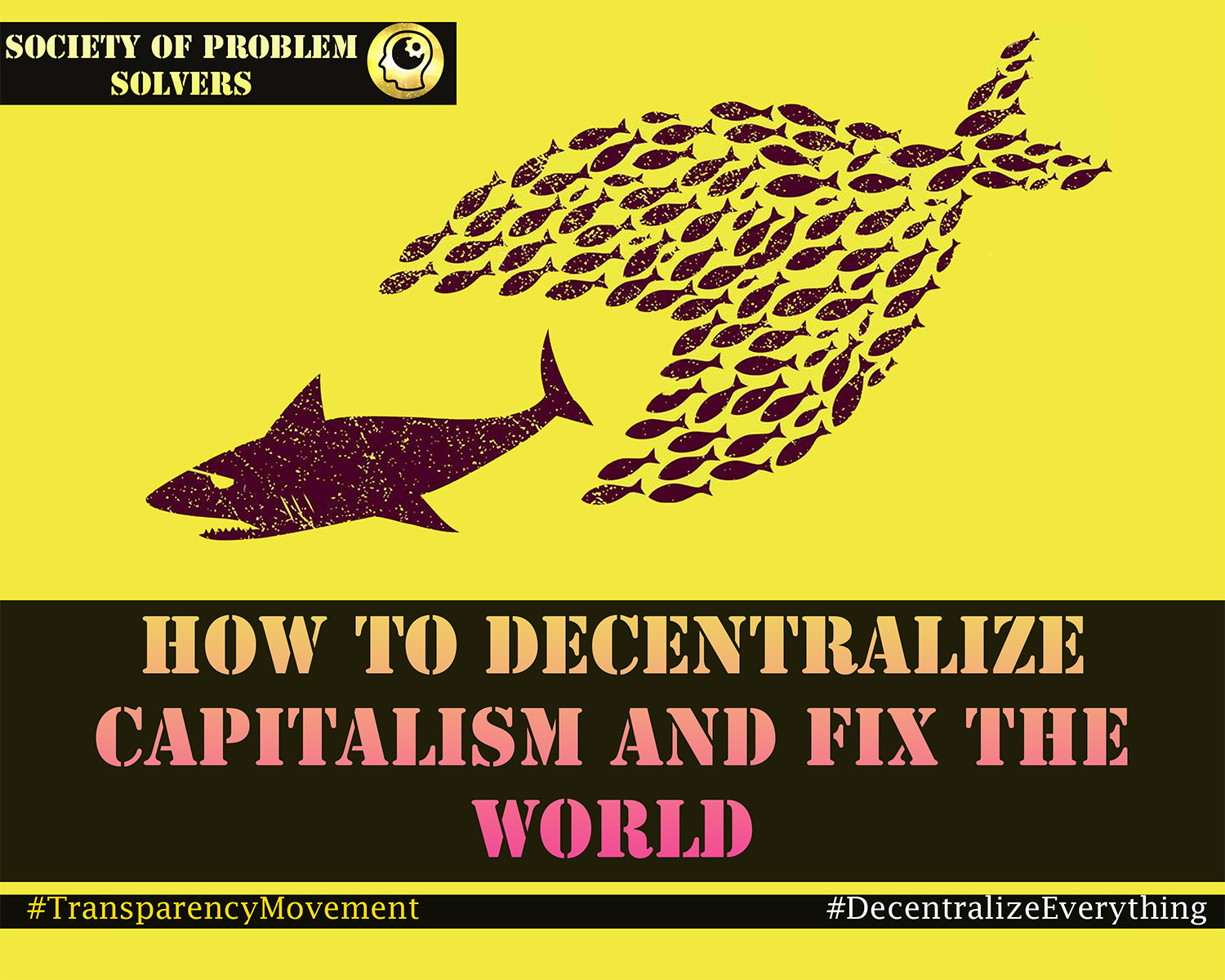
There is more low hanging fruit. As we wrote in our article How To Decentralize and Gamify Capitalism and Fix The World (LINK), we turned crowd owned businesses into a game, much like Sim City but for the real world. We wrote:
”Once we raise a decent amount of players for this game, we can easily obtain several businesses that should already be decentralized. Uber, DoorDash, Spotify, and Amazon don’t need a centralized Wall Street profiting off of them. (people are already understanding this and decentralizing them in some areas). The game could create our own decentralized “swarmed” versions of these, all networked together, making profits, and those profits then would return to our “Impact Pool” of controlled resources.
A CLEAR EXAMPLE:
Imagine if within the game we raised enough money to start our own decentralized Amazon. We were able to make virtually the same exact company with the same prices, selection, benefits, etc. of the existing Amazon, except instead of being owned by Wall Street and Bezos, it was owned by the game. Picture tens of millions of game players tweeting and posting about our new online store… so now all the world knows about it. Let’s say you didn’t play the game but just heard about it when everyone posted about it. Would you continue to spend your money with Wall Street and Bezos so he could buy another yacht and have a $50 million dollar 3rd wedding? Or would you choose to spend it with a 100% transparent company that is run like a game that takes care of its employees, its customers, its communities, itself, and everything it touches?
Game owned businesses would be hard to compete against. The law of supply and demand is on our side. Transparency is on our side. Decentralization is on our side.
As a “Customer Controlled Business” if we demanded more, we could absolutely change everything by decentralizing.”
The technology now exists to coordinate large groups of people at scales that were previously impossible. Technology such as the human collective “swarm” intelligence systems we write about often. (such as HERE and HERE)
What remains missing is the organizational imagination. Most institutions today were designed during eras when centralized control was considered the only practical model. The internet changed that equation, but culturally and economically, society is still catching up to the implications.
If we can avoid tyranny and the digital centralized control of systems like Palantir, CBDCs, and social credit scores, then the future will not belong to governments or corporations, but increasingly to intelligent networks of ordinary people capable of organizing resources, information, and decision-making together. The Spirit Airlines movement, however imperfect, may ultimately be remembered less as a failed airline proposal and more as an early signal that the public is beginning to search for new forms of collective power.
And that is exactly what we have been writing about for five plus years. Systems that are power WITH the people, not POWER OVER them.
Thanks for reading!
Join the decentralized movement and become a Problem Solver! It is free!
Sad news: We lost our forum at SwarmAcademy.ai There was a problem with Digital Ocean and now we are rebuilding it. Until then, please use the comment section here for discourse until we can bring that back.
Stay optimistic! Why? Because..
”All problems that do not defy the laws of physics are solvable with the right knowledge” - David Deutsch
and….
“Humans solve problems better in high-trust groups.”
and…
…… solving problems is happiness!
#CollectiveIntelligence #SwarmIntelligence
For over 3 billion years on this planet there were only single-celled organisms. Then one day they somehow learned to work together and make complex multi-celled creatures . Right now we are like those single-celled organisms. Our next evolution is finding how to work together, better… (like we wrote about here).
#SwarmAcademy #NetworkState #LEADERLESS #ResultsMatterMost #DecentralizeEverything #DemandTransparency
COMMENTS ARE FOR EVERYONE AS A PLACE TO THINK-TANK SOLUTIONS. They will never be for paid-only subscribers and we will never charge a subscription.
This is how we change the world. We build genies - systems of people like this:
Purchasing media outlets that have real world subscriptions and print runs could get the truth out to large chunks of the population that could then finance the next media company.